Suryavanshi IAS provides comprehensive study material, NCERT source mapping, daily current affairs, and standard practice questions for UPSC Civil Services Exam preparation."
The Centre on Monday notified the guidelines to promote domestic manufacturing of electric cars, significantly lowering import duty for foreign manufacturers which pledge to invest in domestic electric vehicle production.
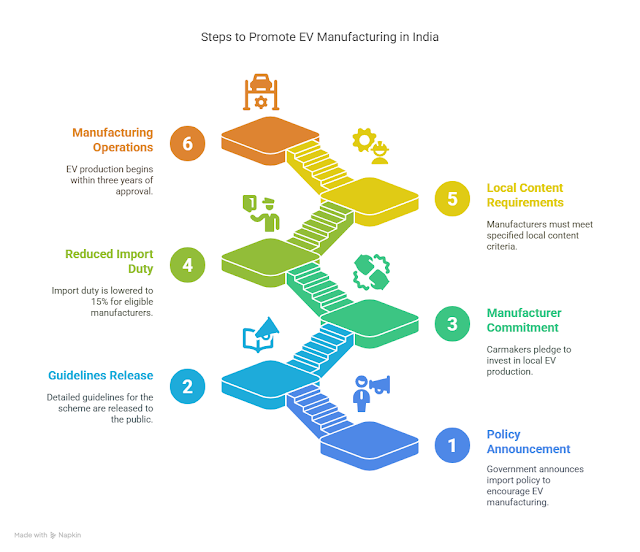
Carmakers will be permitted to import up to 8,000 electric vehicles at a reduced duty rate of 15%, compared with the current 70-100%, provided they commit to invest ₹4,150 crore in local EV manufacturing. They will be required to begin operations within three years of receiving approval and must meet specified local content requirements. The detailed guidelines for the Scheme to Promote Manufacturing of Electric Passenger Cars in India comes 15 months after the government announced its import policy.
During the release of the guidelines, Union Heavy Industries and Steel Minister H.D. Kumaraswamy said the global EV giant Tesla was not interested in manufacturing cars in India. “Tesla... They are more [interested] only to start showrooms. They are not interested to [start] manufacturing in India,” Mr. Kumaraswamy said.
The scheme allows EV manufacturers to import completely built-up cars with a minimum cost-insurance-freight value of $35,000 at a reduced customs duty of 15% for five years from the date of the application approval. The maximum number of electric four-wheelers allowed to be imported at the reduced customs duty will be 8,000 units a year.
In a departure from the 2024 version of the policy, the Union government has also allowed brownfield investments following protests from domestic manufacturers such as Maruti Suzuki India and Tata Motors.
The Centre on Monday notified the guidelines to promote domestic manufacturing of electric cars, significantly lowering import duty for foreign manufacturers which pledge to invest in domestic electric vehicle production.
ReplyDeleteCarmakers will be permitted to import up to 8,000 electric vehicles at a reduced duty rate of 15%, compared with the current 70-100%, provided they commit to invest ₹4,150 crore in local EV manufacturing. They will be required to begin operations within three years of receiving approval and must meet specified local content requirements. The detailed guidelines for the Scheme to Promote Manufacturing of Electric Passenger Cars in India comes 15 months after the government announced its import policy.
ReplyDeleteDuring the release of the guidelines, Union Heavy Industries and Steel Minister H.D. Kumaraswamy said the global EV giant Tesla was not interested in manufacturing cars in India. “Tesla... They are more [interested] only to start showrooms. They are not interested to [start] manufacturing in India,” Mr. Kumaraswamy said.
ReplyDeleteThe scheme allows EV manufacturers to import completely built-up cars with a minimum cost-insurance-freight value of $35,000 at a reduced customs duty of 15% for five years from the date of the application approval. The maximum number of electric four-wheelers allowed to be imported at the reduced customs duty will be 8,000 units a year.
ReplyDeleteIn a departure from the 2024 version of the policy, the Union government has also allowed brownfield investments following protests from domestic manufacturers such as Maruti Suzuki India and Tata Motors.
ReplyDelete